
I’ve been a literacy coach for nearly a decade, through six different job titles and several theories of change (some of them contradictory), with one persistent question: what should a literacy coach know and be able to do?
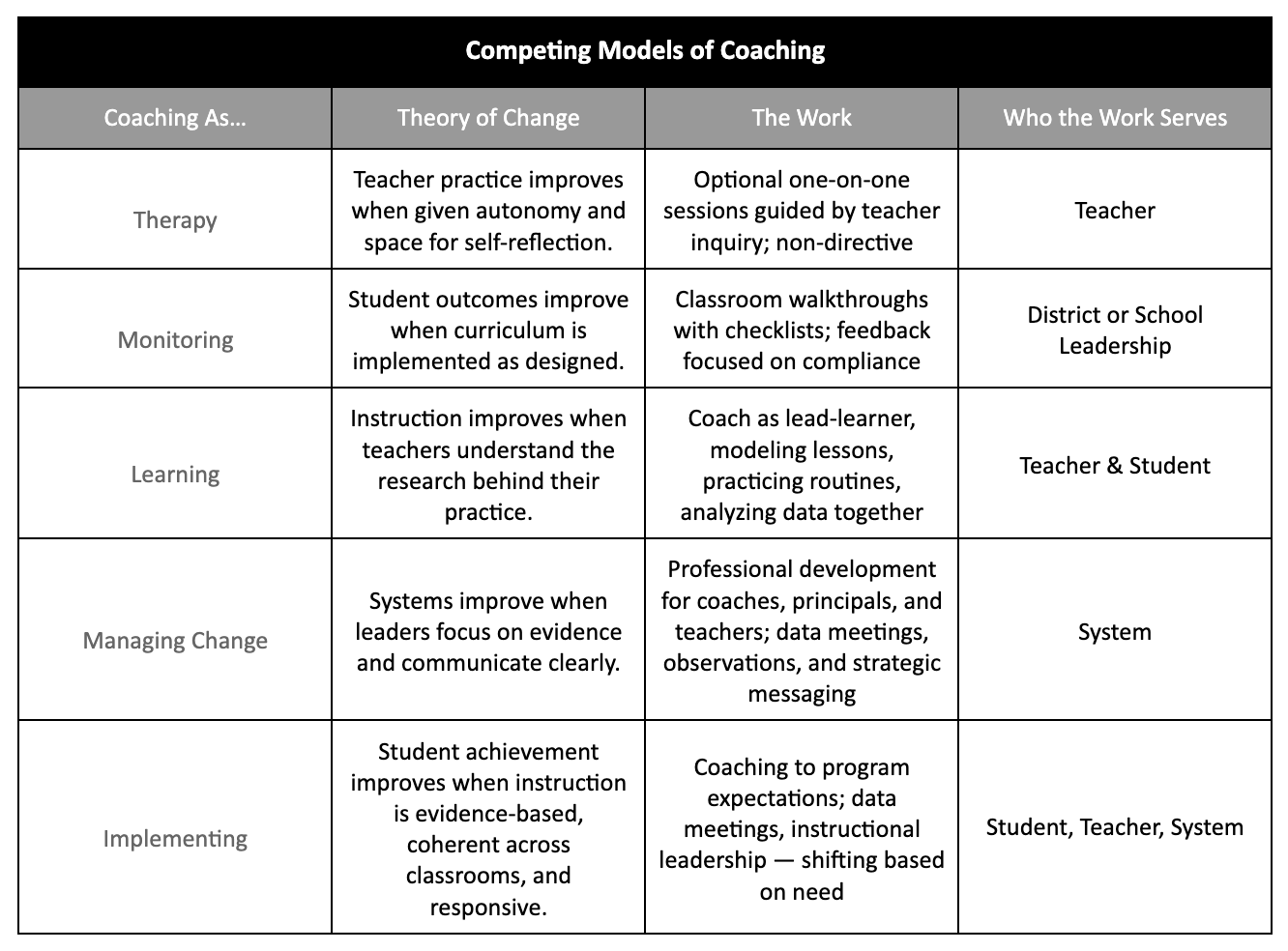
Coaching As Therapy
My first coaching job was a “Common Core Teacher Leader.” State funding was intended to help teachers meet Common Core Standards. My district, however, used its coaches to roll out Balanced Literacy.
Balanced Literacy purported to value teacher autonomy and so did the coaching model we were trained in — Lucy Calkins’ The Art of Teaching Reading was paired with Elena Aguilar’s The Art of Coaching. Teachers could opt into my coaching, or not, and I was meant to facilitate inquiry, not advise them what to change, so our one-on-one meetings felt like therapy. But these ‘arts’ of teaching and coaching were new and uncomfortable in a district that had spent years enforcing compliance.
Coaching As Monitoring
Before the switch to Balanced Literacy, my district had relied on coaches to monitor implementation of the adopted curriculum, Open Court. Coaches walked through classrooms with clipboards, noting which page of the manual each teacher was on. Feedback focused on compliance, how closely teachers were following the pacing guide and the scripted lesson plans. Classroom visits by the Open Court Police were demoralizing.
The district’s adoption of Balanced Literacy promised a new era, and I was lured into the coaching role by the thought of helping teachers to become their best selves. As a site-based literacy coach, I was promised professional development and time with a coach of my own. But old district habits die hard. My coach was, in fact, my supervisor and her trips to my school involved us visiting classrooms carrying clipboards and checklists.
We walked into classrooms to see if Readers Workshop was written on the agenda, whether the classroom library was an ‘inviting comfortable space,’ and if it had ‘shelves and tubs clearly marked with book levels.’
Part of my job was to deliver reading intervention, and I was given scripted lesson plans (“The program is like Reading Recovery in a box!”) and I was told to follow them “with integrity,” a term district supervisors adopted because “fidelity” had become another f-word.
In my first few years of coaching, there were two conflicting theories of change at play. Balanced Literacy proposed that teachers, when taught to observe their students and given the freedom to follow their own judgment, would deliver the instruction that inspired children to enjoy reading and writing. But the district observed teachers struggling to make sense of Lucy Calkins’ verbose lesson plans. In one lesson planning session, a teacher exclaimed, “This woman, Lucy, writes above my independent reading level!” And many teachers, who had delivered scripted phonics lessons for years, didn’t believe that students could love their way into knowing how to read. And so the district’s coaching approach became to require and monitor what it couldn’t inspire.
Coaching As Learning
Once I understood Balanced Literacy’s fatal flaws, I discovered the value of a high-quality lesson script. By teaching a research-based foundational skills program, I learned to establish instructional routines and speak clearly and concisely to my students.
When the teachers I coached said that they wanted to teach the way I was teaching, our sessions shifted. We practiced instructional routines and analyzed student data. My observations focused on instruction more than on classroom environment. Teacher preference gave way to questions about how to do things “the right way.” And while we talked about fidelity to the program, we were striving to understand why the routines were designed as they were. As coach, I became lead-learner, researching the answers to our questions and bringing information back to our staff.
Coaching As Change Management
A grant gave me the opportunity to teach a cohort of coaches what I had learned about research-based reading instruction. We replaced the Balanced Literacy curriculum and began training teachers on how children learn to read and the instruction most likely to ensure every child becomes a skilled reader. I quickly discovered that while the teachers at my own school wanted to teach reading “the right way,” when scaled to include other schools, many teachers balked at being asked to change.
Many teachers felt jerked around by the quick change in curriculum. Schools that adjusted well to the change and began to improve student outcomes all had one thing in common: a strong principal who communicated clearly about the rationale behind the transition. One principal, who had disseminated balanced literacy posters that prompted children to skip or guess tricky words when reading, apologized to her teachers. She explained what she’d learned about that approach and humbly asked teachers to return the posters. When coaches worked alongside principals who were thoughtful about messaging and enthusiastic about learning, teachers were more likely to be curious than resistant.
Getting rid of the running records assessments of Balanced Literacy was a struggle, but once we got valid, reliable, predictive student data, we put it at the center of our meetings with principals, coaches, and teachers. Our cohort of leaders began to see how the strength of implementation, at different schools and across classrooms, impacted student achievement. The data gave us something more persuasive than any philosophical argument about teaching: evidence of what instruction works best for students.
Coaching As Influence Without Control
Managing a big implementation project made me feel simultaneously consequential and disempowered. My decisions affected thousands of students and yet I couldn’t control the minute-by-minute decisions teachers made to ensure strong implementation. I returned to classroom teaching to see if what I’d learned about effective teaching would actually work. And then, once I was more confident, I returned to school-based coaching.
Coaching As Implementing
Since my return to coaching, I’ve been at Nystrom Elementary where I just started my fifth year. In the first year, I strove to ensure teachers could implement our program with fidelity. In the next couple of years, I focused on building teacher capacity to analyze and respond to student data. Then I pushed into new territory, learning more about how language develops and how to teach writing effectively, and my role as coach felt like lead-learner once again. In year five, I’ve discovered that implementation drifts—even after years of solid practice, routines loosen, and I’m back to tightening basics just like I did in year one.
I’ve come to think of this as the real work of coaching — not choosing a model and sticking to it, but knowing which model the moment requires.
We say:
Coaching matters.
We want to develop and retain talented educators.
Even the best athletes have coaches.
Coaching appears in nearly every successful school, district, and state improvement plan. And yet when budgets tighten, coaches are among the first positions cut. Regardless of student need, a literacy coach is seen as a luxury. And for many coaches, time spent actually coaching feels like a rare victory — subbing, covering yard duty, administering tests, handling clerical tasks, and managing school emergencies fill the hours, leaving little time left for helping teachers refine their instruction.
Because coaching is inconsistently defined, districts use the term ‘coach’ when it would be more accurate to say ‘monitor,’ ‘supervisor,’ or ‘admin’s eyes and ears.’ When coaching is mandated — for the teacher who isn’t fully credentialed or is struggling — it becomes synonymous with compliance and remediation. And when it’s optional, the teachers most in need of coaching may not accept the help.
If we aim to ensure that every child becomes a reader, we need to make coaching part of schools’ infrastructure. Where most students are already reading on grade level, a skilled interventionist may be enough. But most schools have needs too big for an interventionist to address.
Every teacher should be able to count on a coach. But we first need to agree on what literacy coaching is for.
So What Next?
Literacy coaching needs what other professions take for granted: agreed-upon standards for what coaches should know and be able to do. We need a professional organization for literacy coaches that would:
- Establish standards of knowledge and skill, defining the competencies a coach needs — from understanding the science of reading, to analyzing student data, to determining which coaching approach a district, school, or teacher needs
- Create a credentialing pathway that gives coaches professional standing
- Disseminate evidence-based coaching practices and build professional expertise
- Advocate for coaching to be available to every teacher whose students have not yet reached proficiency
Coaching has the potential to improve instruction at scale. But we can’t professionalize a job we haven’t bothered to define.







This was so well-said that I feel it my bones. My journey in literacy coaching has also come with multiple theories and approaches as well as changes in job titles and expectations. The fluidity of it has made me a more flexible and knowledgeable educator of literacy, but also brought about constant feelings of unease and instability with district-level decisions affecting when, where, and how this coaching happens. I’m now back in the classroom as a teacher-leader driving positive change, but with a higher workload and the same paycheck as teachers less qualified and less intent on pushing student learning forward. I often feel isolated and that I do not belong in the admin world but don’t really fit in the classroom teaching world either. Thank you for putting your own experience into words so well. I take comfort in knowing there are many others with similar experiences.
Thank you for writing this! I always hang on to your every word, because it is apparent you put research and thought into your words. You always speak to the reality of the topic-which is so appreciated. If you are going to create a course on Coaching, please share it out! I would love to sign up!