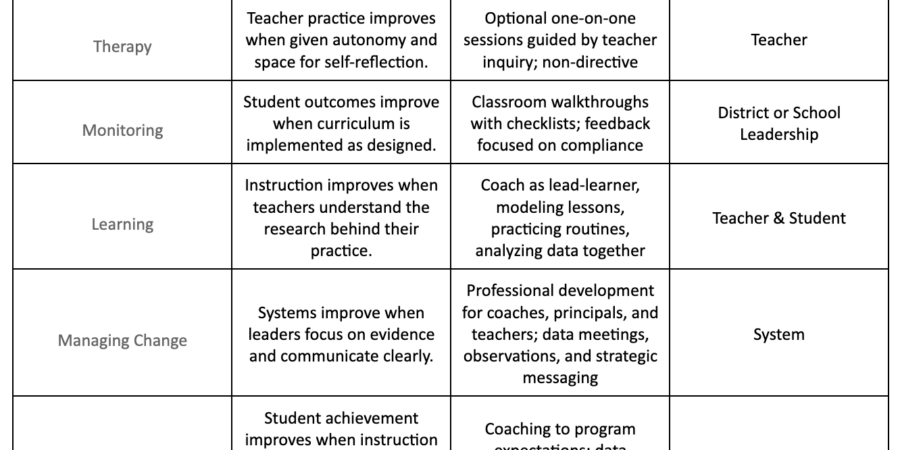
I’ve been a literacy coach for nearly a decade, through six different job titles and several theories of change (some of them contradictory), with one persistent question: what should a literacy coach know and be able to do? Coaching As Therapy My first coaching job was a “Common Core Teacher Leader.” State funding was intended to help teachers meet Common Core Standards. My district, however, used its coaches to roll

Classroom Observations: We Should Do Them, So Why Don’t We?
January 9, 2025
As a classroom teacher, I felt anxious when visitors observed, so as a coach I attributed my nervousness about observations to sympathy pains. But now I know that principals, vice principals, and even coaches rarely watch instruction, and I’ve heard many confessions like this: “I realized that the biggest barrier was in my own head. I actually felt shy about going into classrooms for an in-depth look. It was as
There’s Comfort In Being Wrong
August 10, 2019
Teacher (in a panic): “It can’t be wrong.” Me (softly): “Why not?” Teacher: “Because if it’s wrong and I’ve been doing it for years, then what does that mean for the kids?” Me: “I know, but another teacher said to me, ‘What about the kids we haven’t had yet?’” To consider that we may be wrong is scary. In her TedTalk, On Being Wrong (https://bit.ly/31o0V1o) Kathryn Schulz asks the audience: